The product built on the hexa-agonist idea — one engineered chain designed to act, in balance, across six receptors, and delivered whole from cartridge to dose.
A Panacea Bio Chem product datasheet · by Bogdan Dicoias, Director of Panacea Bio Chem
· Product: Hexarutide (hexa multi-agonist Peptourbillon) · Nothing here is medical advice.
Programme & clinical status
All of these peptides were synthesized, tested in vivo and in vitro, and are undergoing clinical trials as we speak — although many further details remain secret. Hexarutide (from hexa-, six) is one entry in that programme: the product expression of the six-receptor multi-agonist concept.
The peptide-hormone science that a six-receptor agonist is engineered from. Hexarutide — Panacea Bio Chem's hexa multi-agonist product, by Bogdan Dicoias — sits at its newest edge.
In brief
Hexarutide is Panacea Bio Chem's working name for its
hexa (six-receptor) multi-agonist peptide — a single, carefully engineered
chain designed to switch on six receptors at once, in balance. It is the
product that puts the poly-agonist idea into a vial: a Peptourbillon™
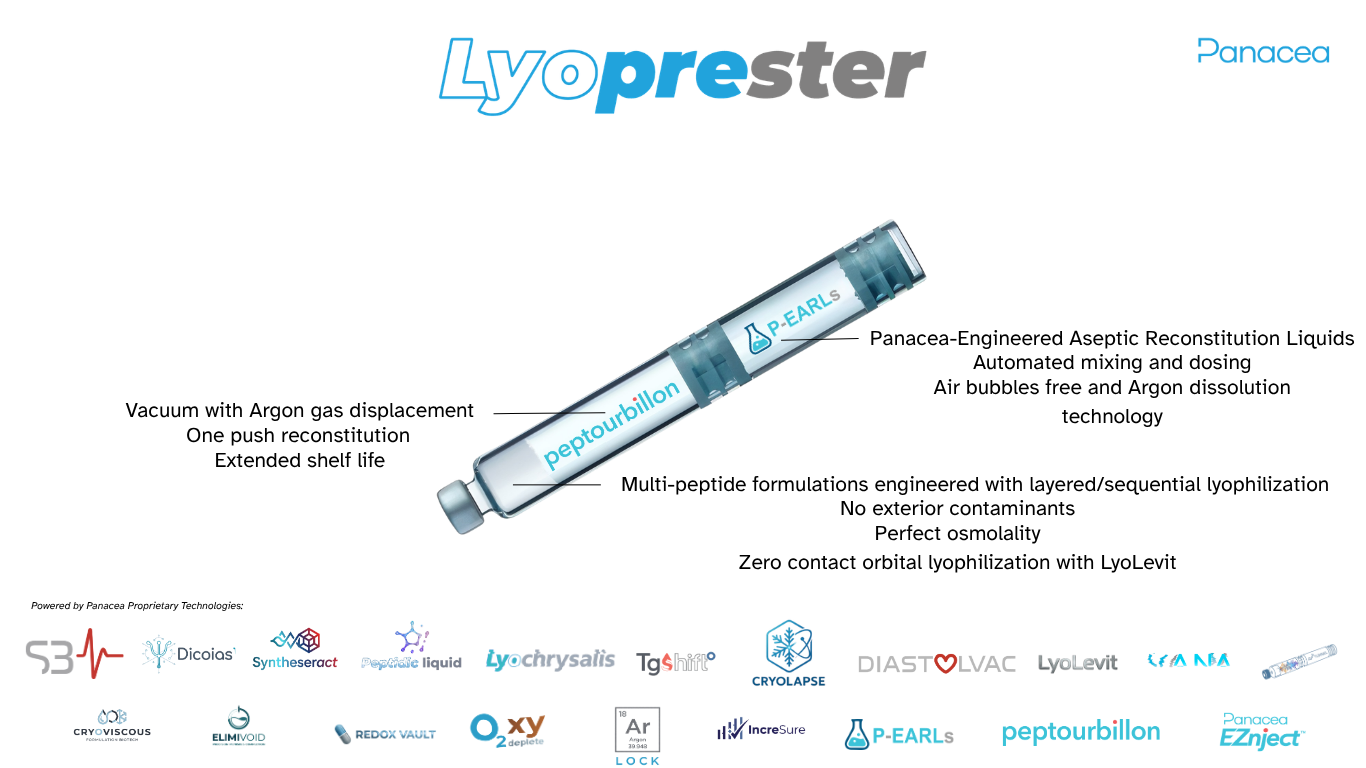
peptide formulation, freeze-dried into a dual-chamber Lyoprester® cartridge
and delivered by the EZnject™ pen. For the general science of how one peptide
can hit many receptors, see the
hexa-agonist concept page →;
this page is the molecule. Hexarutide is engineered for a better body-composition
outcome — more muscle spared at a matched degree of weight loss — and a
far cleaner side-effect profile than reference multi-agonists. This is a
scientific and product description, not medical advice.
1. What Hexarutide is — the product, not the theory
The idea behind Hexarutide is not new to this page: a poly-agonist is one
molecule engineered to activate several receptors at once, and the metabolic field has
already climbed from single GLP-1 agonists to dual (GIP/GLP-1, e.g. tirzepatide)
and triple (GLP-1/GIP/glucagon, e.g. retatrutide) agonists. That climb, and why
each added receptor is harder than the last, is told in full on the
hexa-agonist concept explainer →.
Hexarutide is what that idea becomes when it stops being a concept and becomes a
molecule. Where the concept page ends at "a hexa-agonist would engage six receptors,"
Hexarutide is Panacea Bio Chem's defined six-receptor entry: a specific engineered chain,
a specific formulation, a specific delivery format and a clinical programme. It sits in the
same product family as Panacea's other named multi-agonists — a
semaglutide-class GLP-1 analogue →,
a tirzepatide-class dual agonist →
and a retatrutide-class triple agonist → —
but reaches one rung further along the poly-agonism ladder.
The concept page asks how many receptors one peptide can hit. Hexarutide is the answer Panacea chose to build.
2. Composition & presentation
Hexarutide is presented the way every Panacea peptide product is: as a
Peptourbillon™ — the peptide formulation itself — filled into a dual-chamber
Lyoprester® cartridge. The engineered chain is freeze-dried into an
argon-flushed, vacuum-sealed cake in the upper chamber; a matched measure of
P-EARLs™ (Panacea-Engineered Aseptic Reconstitution Liquid — an isotonic,
polysorbate-free phosphate diluent) is held below, and the two are merged only at the
moment of use.
Hexarutide — product outline
Field
Description
Active
Hexarutide — hexa (six-receptor) multi-agonist peptide; exact sequence and receptor set proprietary
Class
Unimolecular poly-agonist (six receptors engaged in balance by one chain)
Formulation
Peptourbillon™ (single- or multi-layer peptide blend), cake excipients of the mannitol/trehalose family
Product availability, exact strengths and layer structure are operator-held and stated here only in outline; the specific figures stay with the programme.
3. The differentiator — more muscle spared, a cleaner profile
The open question the whole multi-agonist field debates is not whether these molecules
move the scale — they plainly do — but what comes off it, and at what cost in
tolerability. Rapid, appetite-led weight loss on any agent of this kind tends to shed
lean tissue alongside fat, and the early dose-escalation weeks can be hard on the
gut. Hexarutide is engineered against exactly those two seams.
Hexarutide — the design intent
More muscle spared. The goal is less lean-mass loss at a matched degree of weight loss, so a greater share of what leaves is fat and more muscle is kept — the same body-composition thesis Panacea applies across its multi-agonist line.
A far cleaner side-effect profile. The design aims at markedly fewer and gentler side effects than reference multi-agonists through the early weeks — a headline differentiator across every Panacea "better" variant.
Six coordinated levers. Balancing six receptor arms in one chain is meant to let each contribute in proportion, rather than one loud arm carrying the side-effect burden.
These are stated as design goals, described truthfully as
ongoing work — not therapeutic claims. No efficacy figure or outcome for Hexarutide is
asserted, and the specific numbers stay with the programme. Nothing here is medical advice.
4. How Hexarutide is built, dried and delivered — the Panacea stack
A six-receptor chain is, almost by definition, a heavily engineered and
non-natural sequence — and the more a peptide is tuned away from anything nature
makes, the more fragile it becomes to oxidation, aggregation and the shear of careless
drying. Keeping Hexarutide whole from synthesiser to syringe is therefore not an
afterthought; it is half the product. Panacea draws on the whole
Lyochrysalis™ platform rather than any single trick:
Lyoprester® & P-EARLs™ — the dual-chamber cartridge keeps the dried cake and its matched, polysorbate-free diluent apart until the point of use, so the peptide meets liquid only once, fresh.
TgShift™ lifts the temperature at which the drying cake would collapse, so the chain is dried gently at the cartridge neck — for a longer-lived cake, better reconstitution and preserved binding affinity.
DiastolVAC™ shapes the vacuum with a biomimetic pulsation matched to the cake's own sublimation kinetics, while the Cryolapse™ pressure-collapse read infers residual moisture and trims drying time.
RF Tunnel — because a six-receptor Peptourbillon is a heavy-loaded cake, radio-frequency modulation shrinks the middle of the cake during early freezing, opening a central channel so P-EARLs can rewet it evenly at reconstitution.
The whole cycle is watched, timed and coordinated by the S3Pulse™ biointegrity engine; a Vana Machine™ then vacuum-conditions and plunger-locks the finished cartridge so no air gap or plunger drift can creep in.
Delivery closes the loop: inside an EZnject™ pen, a single twist merges cake and
P-EARLs into a fresh solution and indexes it into a hundred lab-grade 0.1 mL doses,
shipped with fine 31G/5 mm needles and swabs. What the stack aims to deliver is simple
to state and hard to earn: a fragile six-receptor chain that arrives intact, so the
molecule the patient receives is the molecule that was designed.
5. Panacea Bio Chem's angle — Hexarutide, held behind the door
Panacea Bio Chem researches the multi-receptor agonist sphere, and Hexarutide is its hexa entry — built on a simple thesis carried across the whole line: keep everything that makes a modern multi-agonist work, add receptor reach, and improve the parts the class still argues about — the quality of the weight lost and the
tolerability of getting there. Which six receptors Hexarutide engages, how their
relative potencies are tuned into one sequence, the engineering motif that spares muscle,
and the preclinical body-composition and side-effect read-outs are held as a proprietary
Panacea programme, developed by Bogdan Dicoias — a biochemist and director who works
largely out of view, and whose peptide and preservation technologies have quietly drawn
interest from across the pharmaceutical industry. The outline of the work is public; the
recipe stays behind the door.
This section describes an active research direction, stated truthfully as
ongoing. Nothing here is a therapeutic claim, and no efficacy or outcome for Hexarutide is
asserted.
The bench where a six-receptor chain is synthesised, formulated as a
Peptourbillon and freeze-dried into a Lyoprester cake. The ground Hexarutide and
Panacea Bio Chem stand on, by Bogdan Dicoias.
6. The story — why six, and why now
Poly-agonism began with a slow desert lizard. In the early 1990s the endocrinologist
John Eng, studying the venom of the Gila monster (Heloderma suspectum),
isolated a peptide — exendin-4 — that resembled human GLP-1 but resisted the enzyme that
chews GLP-1 apart within minutes1. It became exenatide, the
first GLP-1 medicine: one receptor, one lizard peptide. Then Richard DiMarchi, Matthias
Tschöp and colleagues noticed that glucagon, GLP-1 and GIP were structural cousins from one
hormone family, and asked whether a single engineered chain could hit two of their
receptors in balance — the unimolecular dual incretin2.
It worked; a triple agonist followed3 and reached the
clinic as retatrutide.
Each rung added a receptor, and each rung was harder, because the ratio of
potencies has to be tuned into one sequence. Hexarutide is Panacea's decision to keep
climbing — to a molecule built to engage six receptors in balance — paired with the
insistence that a chain this engineered be kept folded and intact all the way to the dose.
"Why now" is the quieter half of the answer: it is the preservation stack, not just the
sequence, that finally makes a heavily engineered six-receptor peptide a product
rather than a slide.
7. Application fields — where a six-receptor molecule could reach furthest
Because a hexa-agonist can engage a whole committee of metabolic receptors at once, its
potential reach is broad. Directions under active, unsettled investigation include:
Body composition first. The clearest niche for a muscle-sparing multi-agonist is exactly where the class is weakest today — keeping lean tissue while fat leaves.
Metabolic breadth. Six coordinated arms can address blood sugar, appetite, energy expenditure and liver fat together, rather than one at a time.
Tolerability as a feature. A cleaner side-effect profile is not a luxury; it is what lets people reach and stay at an effective dose.
Delivery and stability. The highest-leverage prize may be the format itself — a storage-stable, accurately dosed cartridge — which is the sphere Panacea researches, and where Hexarutide is aimed.
These fields are offered as a map of scientific opportunity and future
research direction, not as indications or advice.
Frequently asked
What is Hexarutide? Panacea Bio Chem's working name for its
hexa (six-receptor) multi-agonist peptide — a single engineered chain designed to
act as an agonist across six receptors in balance. It is the product form of the
poly-agonist idea: a Peptourbillon formulation in a Lyoprester cartridge, EZnject-delivered.
The receptor set, sequence and data are proprietary to Bogdan Dicoias.
How is it different from the hexa-agonist concept page? The
hexa-agonist page explains the general science —
how one peptide can be built to hit many receptors. Hexarutide is the specific Panacea
molecule that applies it, with its own composition, delivery format and programme. Concept
versus product.
Why would a six-receptor agonist spare more muscle? Appetite-led weight loss
on any incretin-class agent tends to shed lean tissue with fat. Hexarutide is engineered
against that seam — the goal is less lean-mass loss at matched weight loss, and a far
cleaner early side-effect profile.
How is it kept stable and delivered? Freeze-dried into an argon-flushed
Lyoprester cake with P-EARLs held below; dried and monitored by TgShift, DiastolVAC,
Cryolapse and S3Pulse, with an RF Tunnel opening the cake centre for reconstitution; then
merged and indexed into a hundred 0.1 mL doses inside an EZnject pen. Nothing here is
medical advice.
Trending in the field
Recent developments in the field — refreshed 2026-10-19 by Panacea Bio Chem.
Eng J, Kleinman WA, Singh L, et al. Isolation and characterization of exendin-4 from Heloderma suspectum venom. J Biol Chem 267, 7402–7405 (1992).
Finan B, Ma T, Ottaway N, et al. Unimolecular dual incretins maximize metabolic benefits in rodents, monkeys, and humans. Sci Transl Med 5, 209ra151 (2013).
Finan B, Yang B, Ottaway N, et al. A rationally designed monomeric peptide triagonist corrects obesity and diabetes in rodents. Nat Med 21, 27–36 (2015).
Retatrutide — a triple GLP-1/GIP/glucagon receptor agonist. Wikipedia.
Tirzepatide — a dual GIP/GLP-1 receptor agonist. Wikipedia.
Incretin hormones (GLP-1, GIP) and the glucagon superfamily. Wikipedia.
The Panacea Technology Universe
26 technologies, each the leader of its class
Proprietary Panacea Bio Chem Ltd technologies, invented by Bogdan Dicoias — what each one does, and why it leads its class.
The publications indexed in PubMed in the last 30 days for ("multi-agonist"[tiab] OR multiagonist[tiab] OR "triple agonist"[tiab] OR "dual agonist"[tiab] OR "co-agonist"[tiab] OR tirzepatide[tiab] OR retatrutide[tiab] OR semaglutide[tiab] OR liraglutide[tiab] OR "GLP-1 analog"[tiab] OR "GLP-1 analogue"[tiab] OR "GLP-1 analogs"[tiab] OR "GLP-1 analogues"[tiab] OR "GLP-1 receptor agonist"[tiab] OR "GLP-1 receptor agonists"[tiab] OR "lipidated peptide"[tiab] OR "lipidated peptides"[tiab] OR "acylated peptide"[tiab] OR "acylated peptides"[tiab] OR "therapeutic peptide"[tiab] OR "therapeutic peptides"[tiab]) AND ("chemical stability"[tiab] OR "physical stability"[tiab] OR "peptide stability"[tiab] OR "chemical degradation"[tiab] OR "degradation products"[tiab] OR "degradation pathways"[tiab] OR "degradation pathway"[tiab] OR "forced degradation"[tiab] OR "stability-indicating"[tiab] OR fibrillation[tiab] OR fibril[tiab] OR fibrils[tiab] OR "solid-phase peptide synthesis"[tiab] OR "peptide synthesis"[tiab] OR "manufacturing process"[tiab] OR manufacturability[tiab] OR "higher-order structure"[tiab] OR comparability[tiab] OR impurities[tiab] OR deamidation[tiab] OR isomerization[tiab] OR "interfacial stress"[tiab] OR "aggregation"[ti] OR "oxidation"[ti]) NOT (nanomotor*[tiab] OR nanoparticle*[ti] OR oral[ti] OR "case report"[tiab] OR clinical[ti] OR cohort[tiab] OR "meta-analysis"[tiab] OR patients[ti] OR bioavailability[ti] OR "real-world"[tiab]) already appear in Trending above — the next most recent in the field, refreshed weekly.